By Jeff Baldock, MA, MSW, RSW
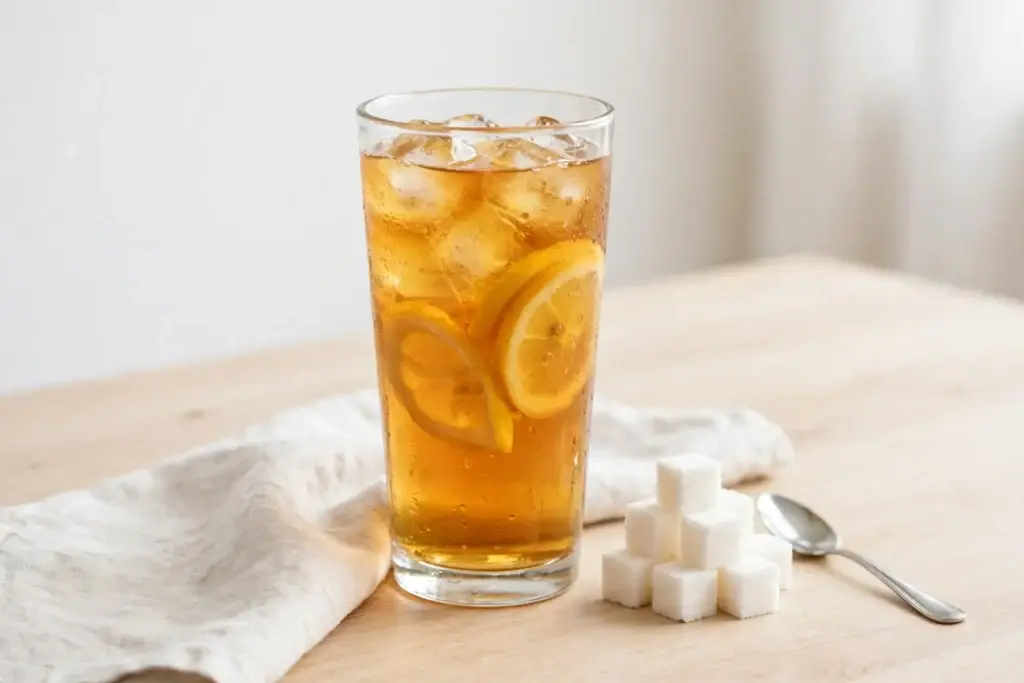
Picture a glass of water. Stir in 11 teaspoons of sugar, one level spoonful after another. Would you drink it? Would you hand it to a child?
That is one 500 mL bottle of lemon iced tea. The label says 43 grams of sugar, and at 4 grams to the teaspoon, that is almost 11. Cola is no better. The World Health Organization notes that a single can of sugar-sweetened soda holds up to 40 grams of free sugars, around 10 teaspoons. [1]
Kids drink these without a second thought. So do plenty of adults. This is for both.
How much is allowed
The American Heart Association recommends that children aged 2 to 18 take in less than 25 grams, or 6 teaspoons, of added sugar a day. [2] It also says sugary drinks should be limited to no more than 8 ounces per week, and that children under 2 should have none. [2] Not one pop a day. One small glass a week.
A 20-ounce bottle of soda alone can carry upwards of 16 teaspoons of added sugar.
Adults get little more room. The AHA has set the daily limits at 6 teaspoons for women and 9 for men. [14] The WHO advises that adults and children keep free sugars under 10% of their daily energy, and says going below 5%, roughly 25 grams, would bring added benefit. [1]
So one bottle of pop puts a child at close to double the daily limit. A second bottle at lunch puts that child at nearly four times.
What sugar does inside the body
The AHA reviewed the evidence on children and concluded that strong evidence ties added sugars to higher cardiovascular risk through more energy intake, more body fat, and unhealthy blood fats. [2] A review of sugary drinks and children’s health found clear evidence that they raise the risk of overweight, obesity, and tooth decay, with emerging evidence linking them to diabetes. [3]
Then there are the blood vessels. The image I use is gravel scraping the inside of a pipe. It is a picture, not a literal description, but the biology behind it is real. A high-glucose environment impairs the ability of the vessel lining to relax and widen, and it brings inflammation and oxidative stress. [4] In one line of research, a jump in blood sugar after a glucose drink reduced that widening response within one to two hours, even in people without diabetes. [4] Most of this work comes from people with diabetes or from cell studies, so I am not claiming one bottle injures a child’s arteries. The concern is the habit, repeated daily for years.
What it does to adults
Adults are not protected by age. A 2024 umbrella review pooled 47 meta-analyses covering more than 22 million people. It found convincing evidence linking sugary drinks to cardiovascular disease, type 2 diabetes, depression, kidney stones, and higher uric acid, and highly suggestive evidence for fatty liver disease and tooth decay. [5]
The size of the risk is not small. A Harvard review found that people who drank one or two sugary drinks a day had a 35% higher risk of heart attack or fatal heart disease, a 16% higher risk of stroke, and a 26% higher risk of type 2 diabetes than people who drank fewer. [6] The liver is part of the reason. It converts fructose into fatty compounds, which may lead to fatty liver disease and insulin resistance. [6]
The brain is less settled. In a UK study of more than 118,000 people, drinking more than one glass of sugar-sweetened beverage a day was tied to a higher risk of dementia, with a hazard ratio of 1.61. [7] A Framingham study linked higher sugary drink intake to lower total brain volume and poorer memory performance. [8] But a pooled analysis of six US cohorts of people over 65 found no link between sweetened drinks and dementia. [9] These are observational studies. They show association, not cause.
The energy that is not really energy
Parents know this scene. The pop goes in, and soon the child is running too fast, throwing things, shoving a sibling. I have watched children get blamed for exactly that behaviour.
The research says to be careful about where we place the cause. A meta-analysis of 23 controlled studies concluded that sugar does not affect children’s behaviour or cognitive performance. [10] The authors added that parents’ strong belief may come from expectation, and that a small effect, or an effect on a subset of children, cannot be ruled out. [10] In one test, parents were told their child had been given sugar when the drink was actually a sweetener. Those parents rated their kids as more hyperactive, stayed closer to them, and were more demanding. [15]
So I will not tell parents that sugar makes children hyper. What I can say is that a cola also carries caffeine, a stimulant, and that a child who is wound up and sitting at a desk has nowhere to put it. The pop helps set that child up to fail.
The sweet tooth question
Many people believe sugar trains the palate, so that the more you eat, the more you want, and plainer foods lose their appeal. The research does not settle it.
One controlled trial had adults cut simple sugars for several months. It found that changing sugar intake changed how intense sweet foods tasted, and the authors said more work was needed to know whether it shifts preference. [11] When the participants were allowed to eat freely again, they went back to their old sugar intake and their old sweetness ratings. [11] A 2023 review judged that changing sweetness preference through diet is still a hypothesis and not scientifically proven. [12] That review’s author works for the German Sugar Association, so weigh it accordingly.
What is better supported is displacement. Children who eat foods loaded with added sugars tend to eat fewer fruits, vegetables, whole grains, and dairy. [2] And habits pass down. In an Australian birth cohort, infants whose mothers drank soft drinks every day were 1.8 times as likely to have been given foods and drinks with added sugars by six to nine months as infants whose mothers never drank them. [13]
A child raised on pop learns that pop is normal, and the sweet drink crowds out the food that should be on the plate. Whether it rewires taste itself, nobody has proven. Habit is the stronger ground.
Any benefits?
Pop has calories and nothing else. A treat now and then is a treat. A daily habit is something else.
What to do instead
Water for most of the day. Milk is fine. If you or your child want flavour, drop lemon slices or berries in a jug. Save pop for birthdays. Read the label, divide the grams of sugar by four, and you have your teaspoons. Then picture them in a cup of tea.
Sources
- World Health Organization. Guideline: Sugars Intake for Adults and Children. Geneva: World Health Organization; 2015.
- Vos MB, Kaar JL, Welsh JA, Van Horn LV, Feig DI, Anderson CAM, Patel MJ, Munos JC, Krebs NF, Xanthakos SA, Johnson RK. Added sugars and cardiovascular disease risk in children: a scientific statement from the American Heart Association. Circulation. 2017;135(19):e1017–e1034. doi:10.1161/CIR.0000000000000439. Published online August 22, 2016.
- Bleich SN, Vercammen KA. The negative impact of sugar-sweetened beverages on children’s health: an update of the literature. BMC Obesity. 2018;5:6. doi:10.1186/s40608-017-0178-9.
- Kawano H, Motoyama T, Hirashima O, Hirai N, Miyao Y, Sakamoto T, Kugiyama K, Ogawa H, Yasue H. Hyperglycemia rapidly suppresses flow-mediated endothelium-dependent vasodilation of brachial artery. J Am Coll Cardiol. 1999;34(1):146–154. doi:10.1016/S0735-1097(99)00168-0.
- Lane MM, Travica N, Gamage E, Marshall S, Trakman GL, Young C, Teasdale SB, Dissanayaka T, Dawson SL, Orr R, Jacka FN, O’Neil A, Lawrence M, Baker P, Rebholz CM, Du S, Marx W. Sugar-sweetened beverages and adverse human health outcomes: an umbrella review of meta-analyses of observational studies. Annu Rev Nutr. 2024;44(1):383–404. doi:10.1146/annurev-nutr-062322-020650.
- Malik VS, Hu FB. Fructose and cardiometabolic health: what the evidence from sugar-sweetened beverages tells us. J Am Coll Cardiol. 2015;66(14):1615–1624. doi:10.1016/j.jacc.2015.08.025.
- Kim JH, Kwon YJ, Lee Y, Han T, Lim MY, Heo SJ, Lee JW. Associations of individual beverage types and substitution with dementia risk: a UK Biobank cohort study. J Nutr Health Aging. 2026;30(1):100740. doi:10.1016/j.jnha.2025.100740. Published online November 27, 2025.
- Pase MP, Himali JJ, Jacques PF, DeCarli C, Satizabal CL, Aparicio H, Vasan RS, Beiser AS, Seshadri S. Sugary beverage intake and preclinical Alzheimer’s disease in the community. Alzheimers Dement. 2017;13(9):955–964. doi:10.1016/j.jalz.2017.01.024.
- Chen H, Ding Y, Dhana K, et al. Sweetened beverages and incident all-cause dementia among older adults. JAMA Psychiatry. Published online June 18, 2025. doi:10.1001/jamapsychiatry.2025.1230.
- Wolraich ML, Wilson DB, White JW. The effect of sugar on behavior or cognition in children: a meta-analysis. JAMA. 1995;274(20):1617–1621. doi:10.1001/jama.1995.03530200053037.
- Wise PM, Nattress L, Flammer LJ, Beauchamp GK. Reduced dietary intake of simple sugars alters perceived sweet taste intensity but not perceived pleasantness. Am J Clin Nutr. 2016;103(1):50–60. doi:10.3945/ajcn.115.112300.
- Prinz P. Sweetness preference and its impact on energy intake and body weight: a review of evidence. Front Nutr. 2023;10:1289028. doi:10.3389/fnut.2023.1289028.
- Ha DH, Do LG, Spencer AJ, Thomson WM, Golley RK, Rugg-Gunn AJ, Levy SM, Scott JA. Factors influencing early feeding of foods and drinks containing free sugars: a birth cohort study. Int J Environ Res Public Health. 2017;14(10):1270. doi:10.3390/ijerph14101270.
- Johnson RK, Appel LJ, Brands M, Howard BV, Lefevre M, Lustig RH, Sacks F, Steffen LM, Wylie-Rosett J. Dietary sugars intake and cardiovascular health: a scientific statement from the American Heart Association. Circulation. 2009;120(11):1011–1020. doi:10.1161/CIRCULATIONAHA.109.192627.
- Hoover DW, Milich R. Effects of sugar ingestion expectancies on mother-child interactions. J Abnorm Child Psychol. 1994;22(4):501–515. doi:10.1007/BF02168088.